All your money, in one place.
- Role
- Product Designer, self-initiated
- Type
- Concept
- Platform
- iPhone app
- Timeline
- Six weeks, September to October 2026
PayéNet is a concept. The Bank of Mauritius has announced a proof of concept for open finance without saying much about what’s in it, so I designed how I’d see it. The banks are real; the people, the amounts and the app are mine.
How I got there
Why a concept?
Like most people here, my money sits in three places. Open banking would let one app see all of them, and pay from any of them. The Bank of Mauritius has announced a proof of concept for open finance. I don’t know what’s in it, so I asked myself how I would do it.
How I worked on it
Research
Problem
Product
Flows
Identity
Screens
MePicked the questions, read the findings against my own banks
Framed it around three people, not one average user
Decided what it is, and what it never does
Drew the flows before any screen, failures included
The name, ink line drawings of real places, one yellow
Directed and corrected every screen in Figma
Searched and cited the sources, scraped 2,657 store reviews
People only
Questioned the assumptions
Checked them against the research
Explored illustration styles
Drew them from my specs
- ResearchEmpathise
- Picked the questions, read the findings against my own banksAISearched and cited the sources, scraped 2,657 store reviews
- ProblemDefine
- Framed it around three people, not one average userPeople only
- ProductDefine
- Decided what it is, and what it never doesAIQuestioned the assumptions
- FlowsIdeate
- Drew the flows before any screen, failures includedAIChecked them against the research
- IdentityIdeate
- The name, ink line drawings of real places, one yellowAIExplored illustration styles
- ScreensPrototype
- Directed and corrected every screen in FigmaAIDrew them from my specs
Six weeksSeptember to October 2026261 sources and 2,657 store reviews, digested with AI148 screens in Figma
Three questions before drawing anything
Is getting a bank account the problem?
What does a bank ask before a home loan?
Who gets left out?
What the research changed
Apps that only show your accounts keep closing
Money Dashboard, Yolt and Spiir all shut down. The ones still around earn from something else. That’s why PayéNet also pays, moves money between your banks and helps you borrow.
Half the people who connect drift away
51% of data-sharing arrangements lapsed or were cancelled, after about five months on average. So Home is built around a question that comes back every month: will the money last until payday?
More than one connection in four fails at the bank
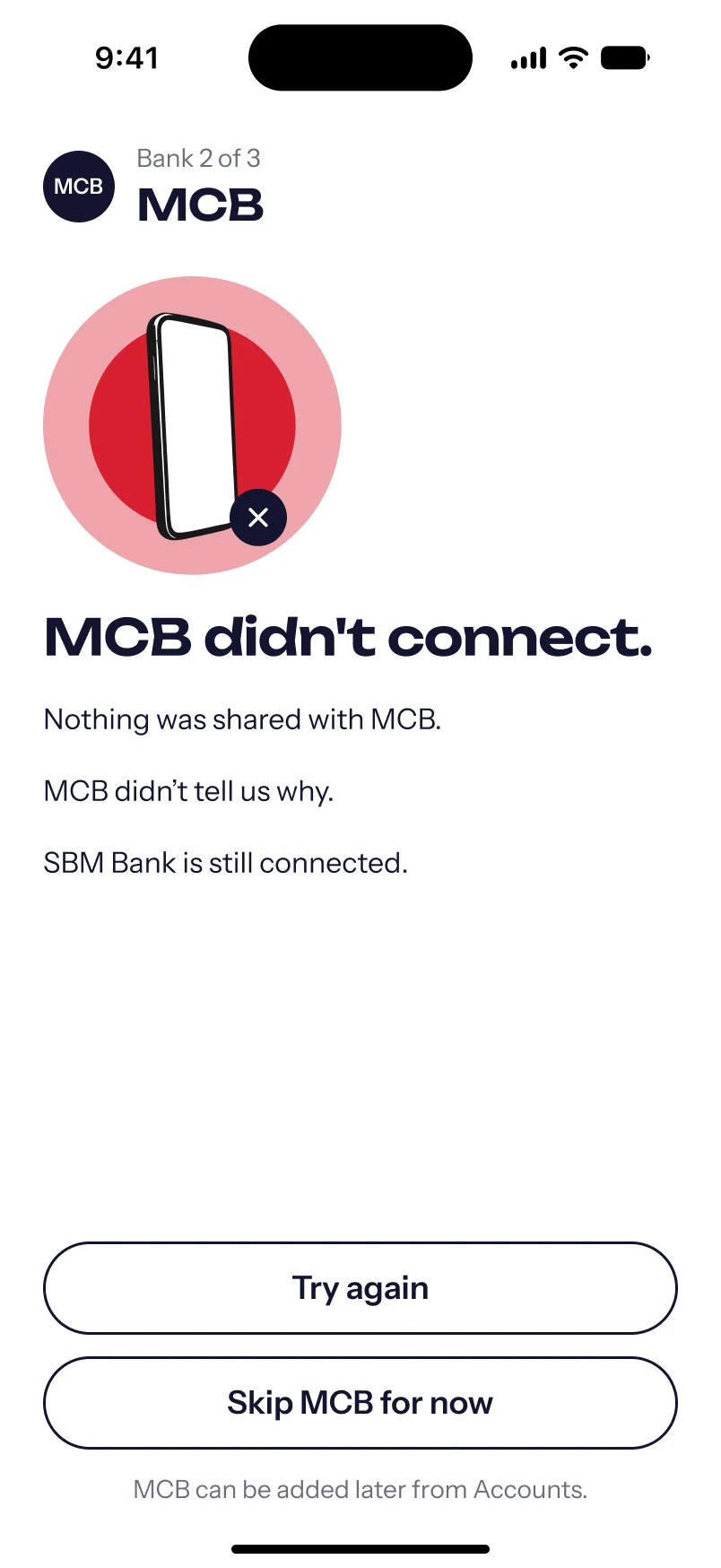
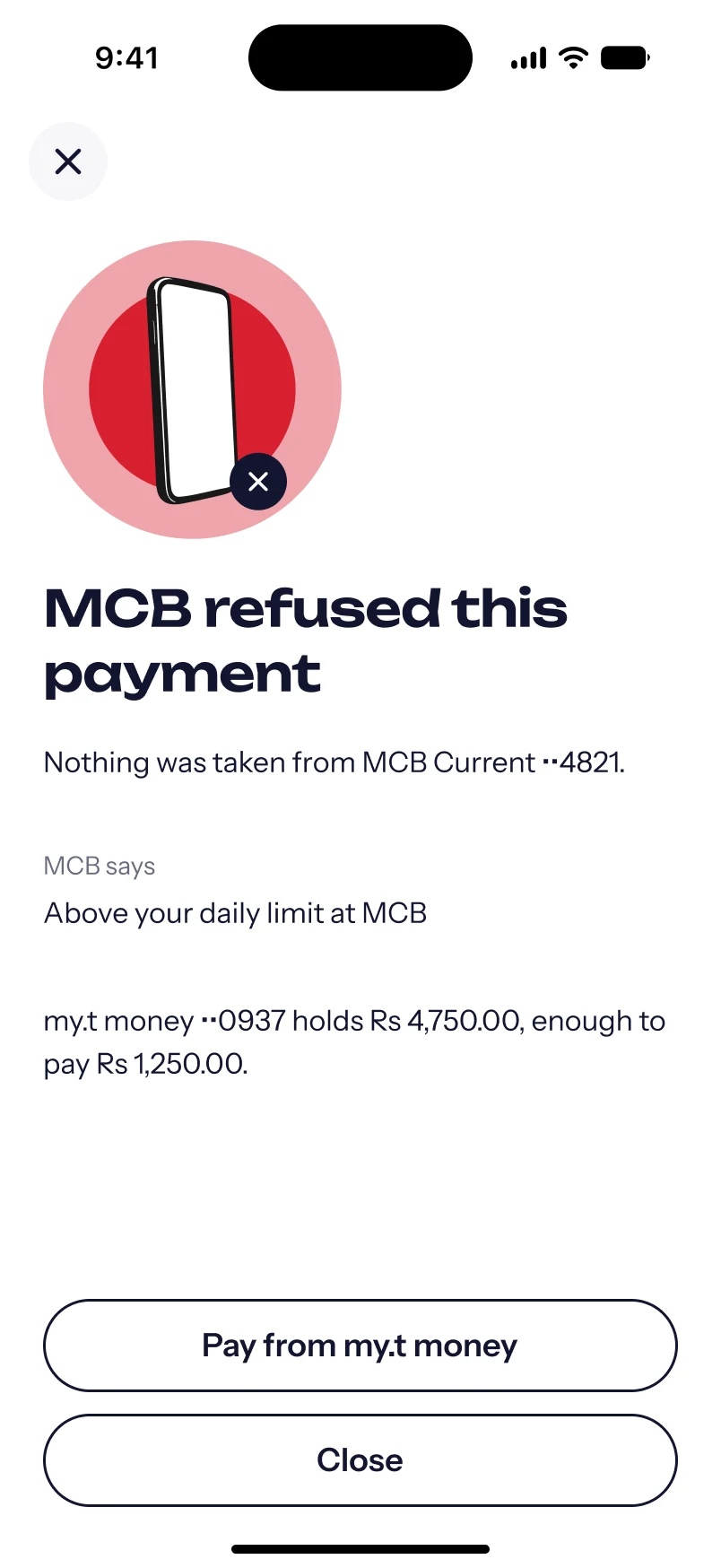
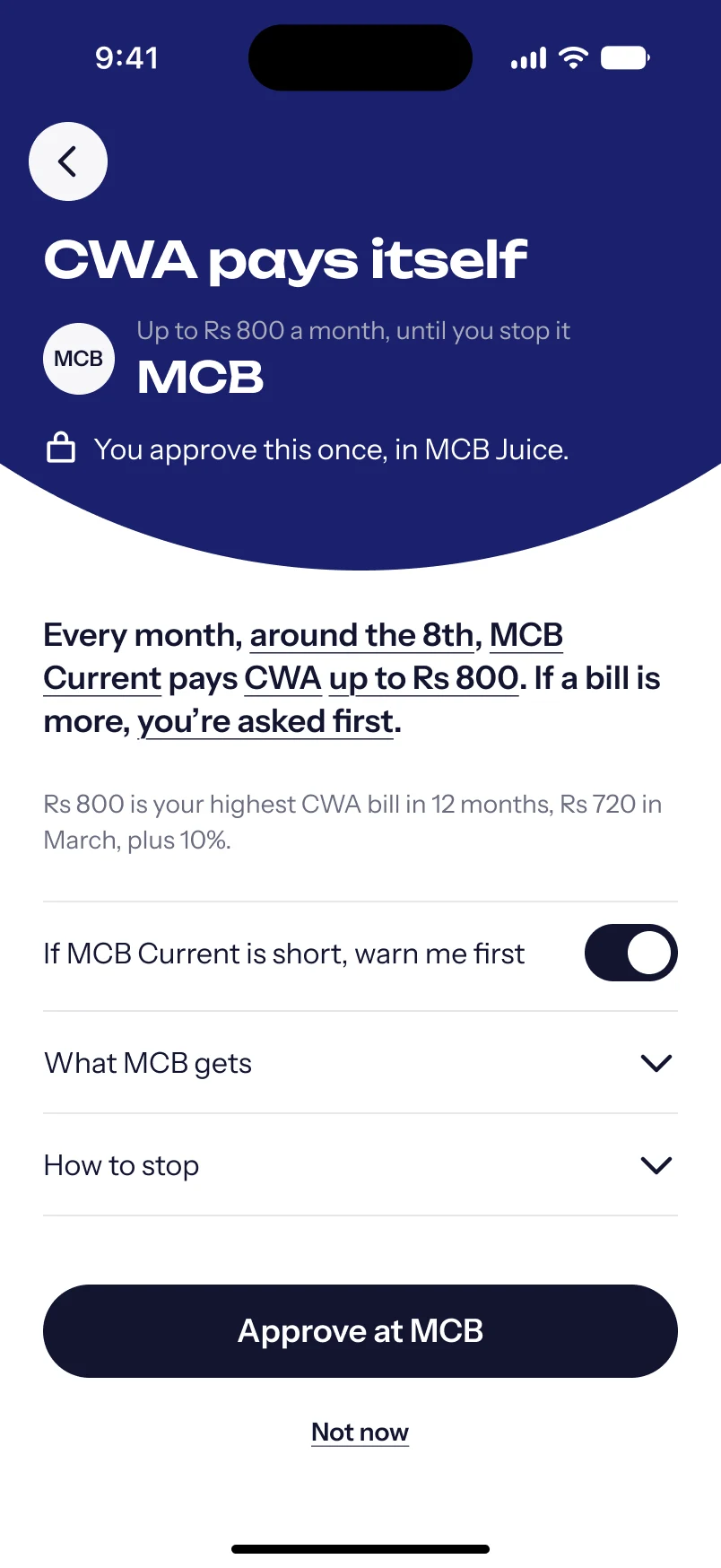
27% of attempts failed at the bank’s step, and the sources don’t agree on whose fault that is. So every flow has its failure screens, and each one says what to do next.
People forget how to stop sharing
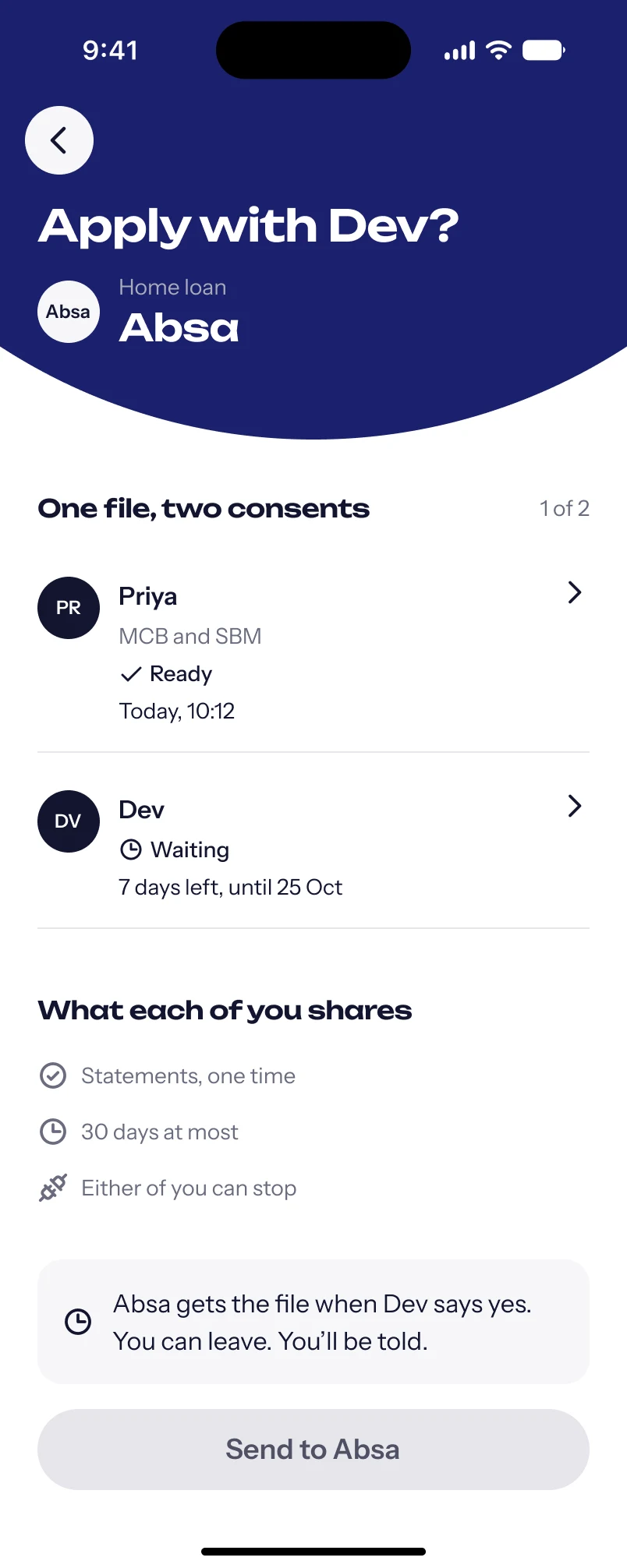
Over three rounds of testing a consent screen, the share who understood how to withdraw fell from 74% to 47%. So how long it lasts and how to stop each get a line of their own.
What PayéNet is, and what it isn’t
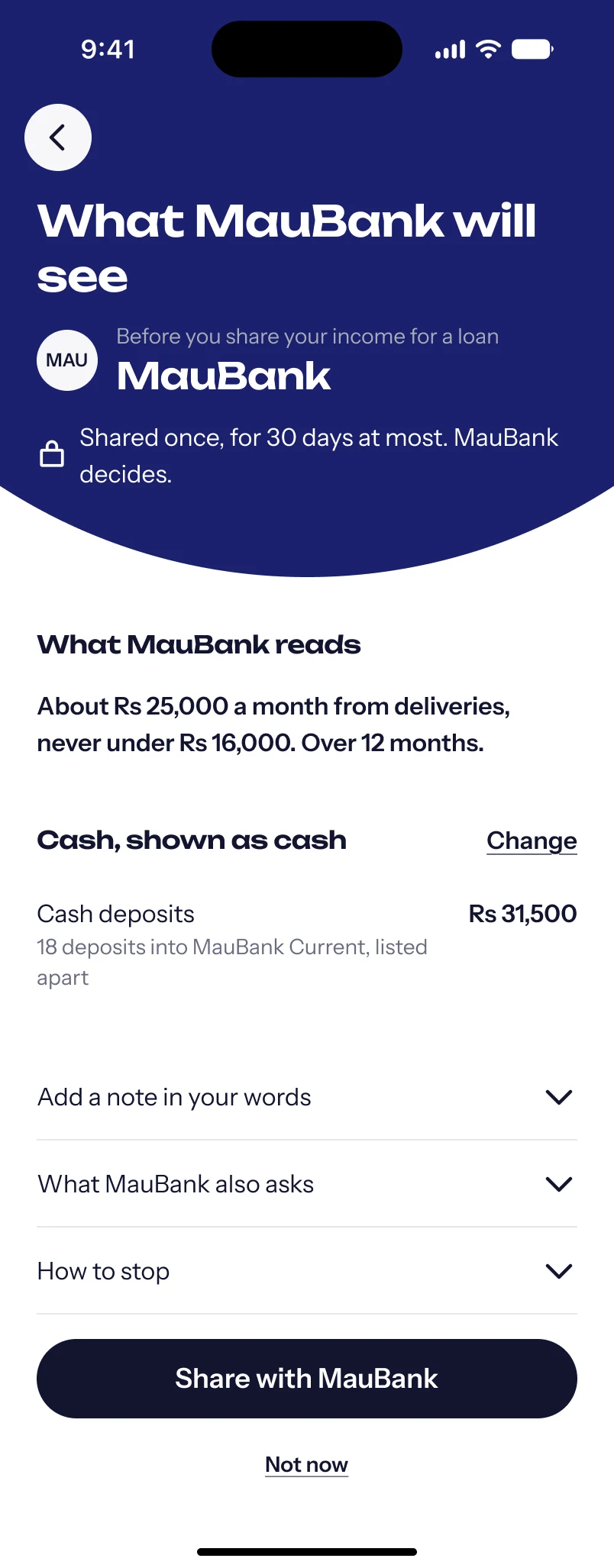
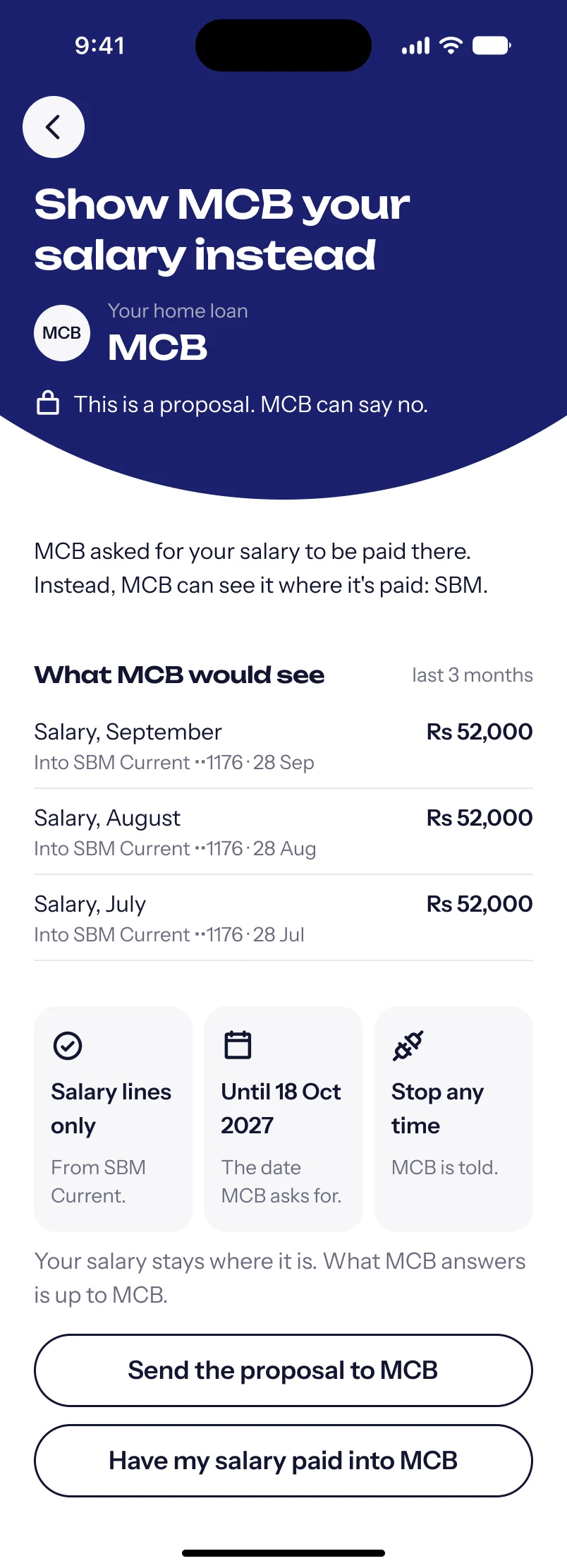
PayéNet puts every bank and wallet account in one app, pays from the one you choose, and lets you share your own data with a lender when you decide.
It isn’t a bank or a lender, and it doesn’t score anyone.
One identity, three apps
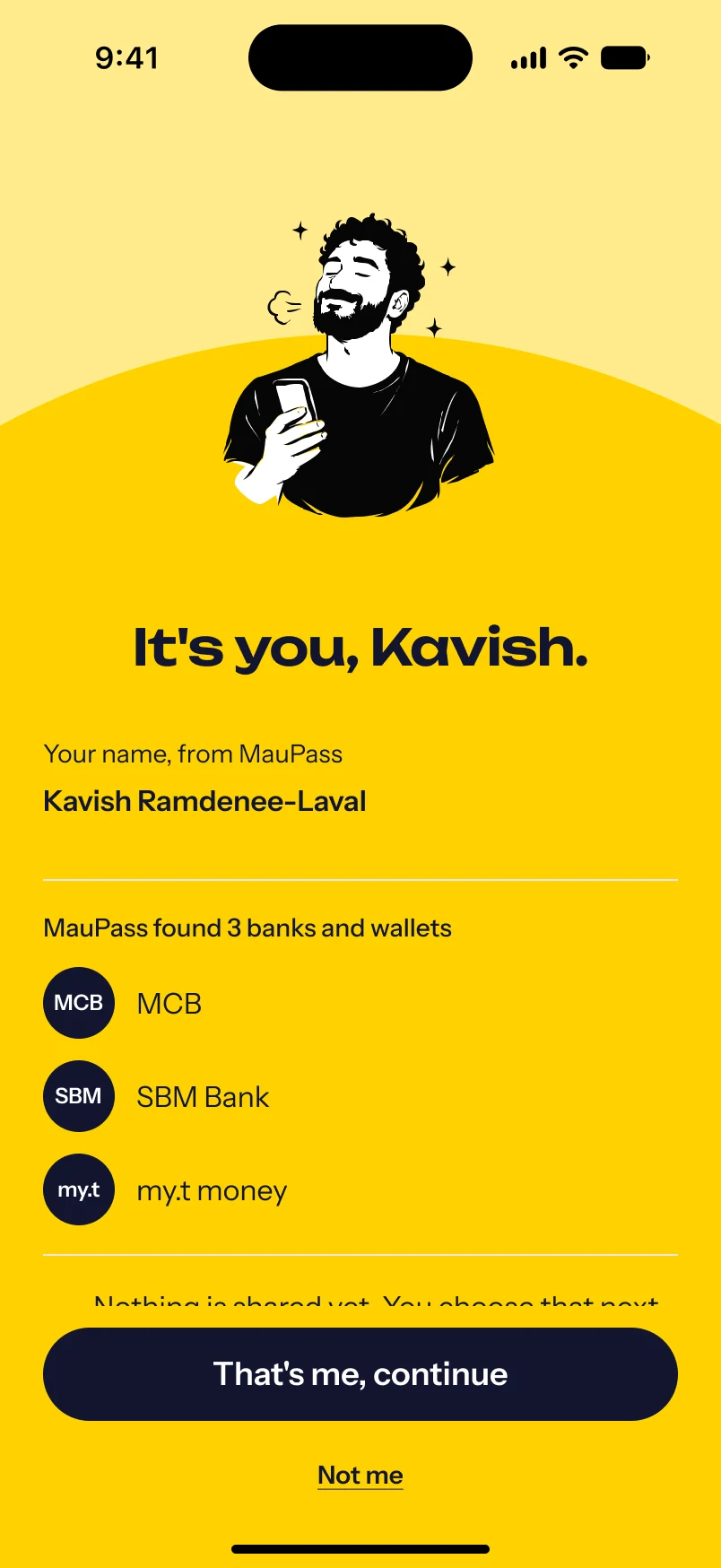
PayéNet leans on MauPass to sign you in. But MauPass today isn’t really what Singapore has with Singpass, or Malaysia with MyKad and MyDigital ID. In Singapore, one app signs you in, shares your details with a bank when you say so, and signs documents. Here, you prove who you are once, at a Mauritius Post office with your ID card. Then you sign in with KOREK on your phone, and you sign documents in MWA, another government app.
So why three apps? Why aren’t proving who you are, signing in and signing a document one and the same app? PayéNet would be simpler with one, and so would everything else.
Flows before screens, failures included
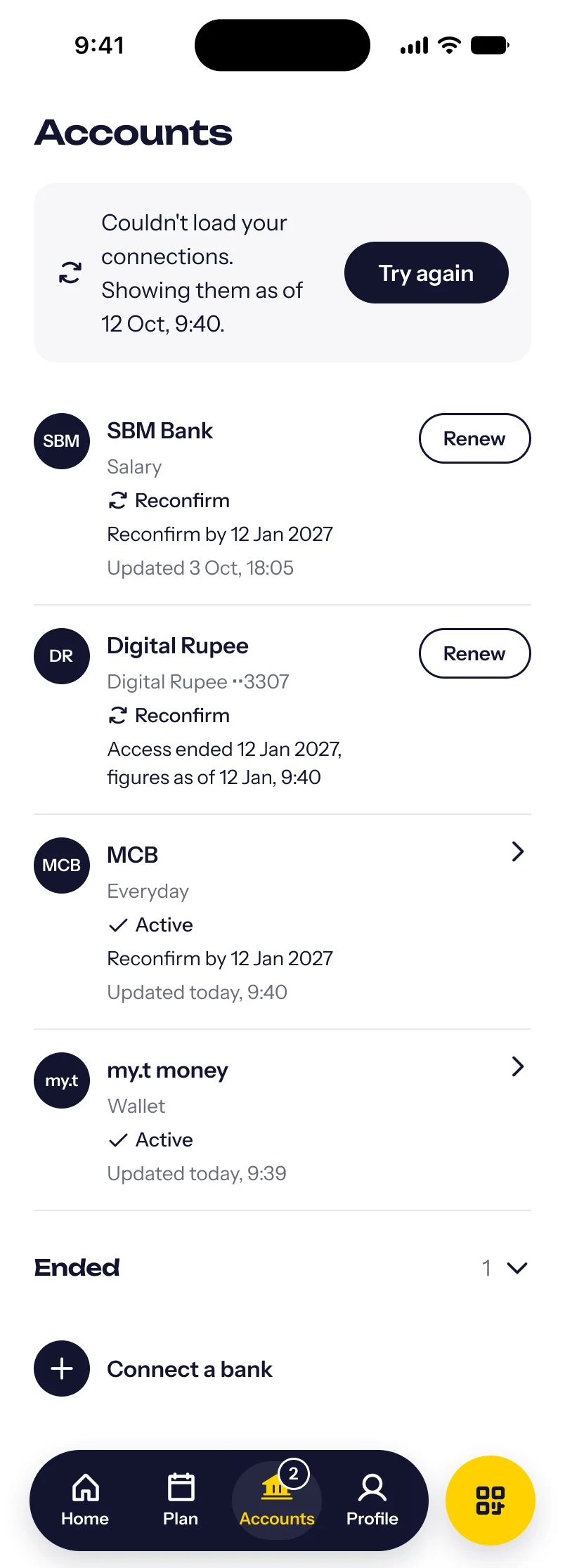
Every flow was drawn with its loading, error and offline states before any screen. The app file has 148 screens, and 64 of them are loading, waiting or failure states.
Giving a Mauritian identity
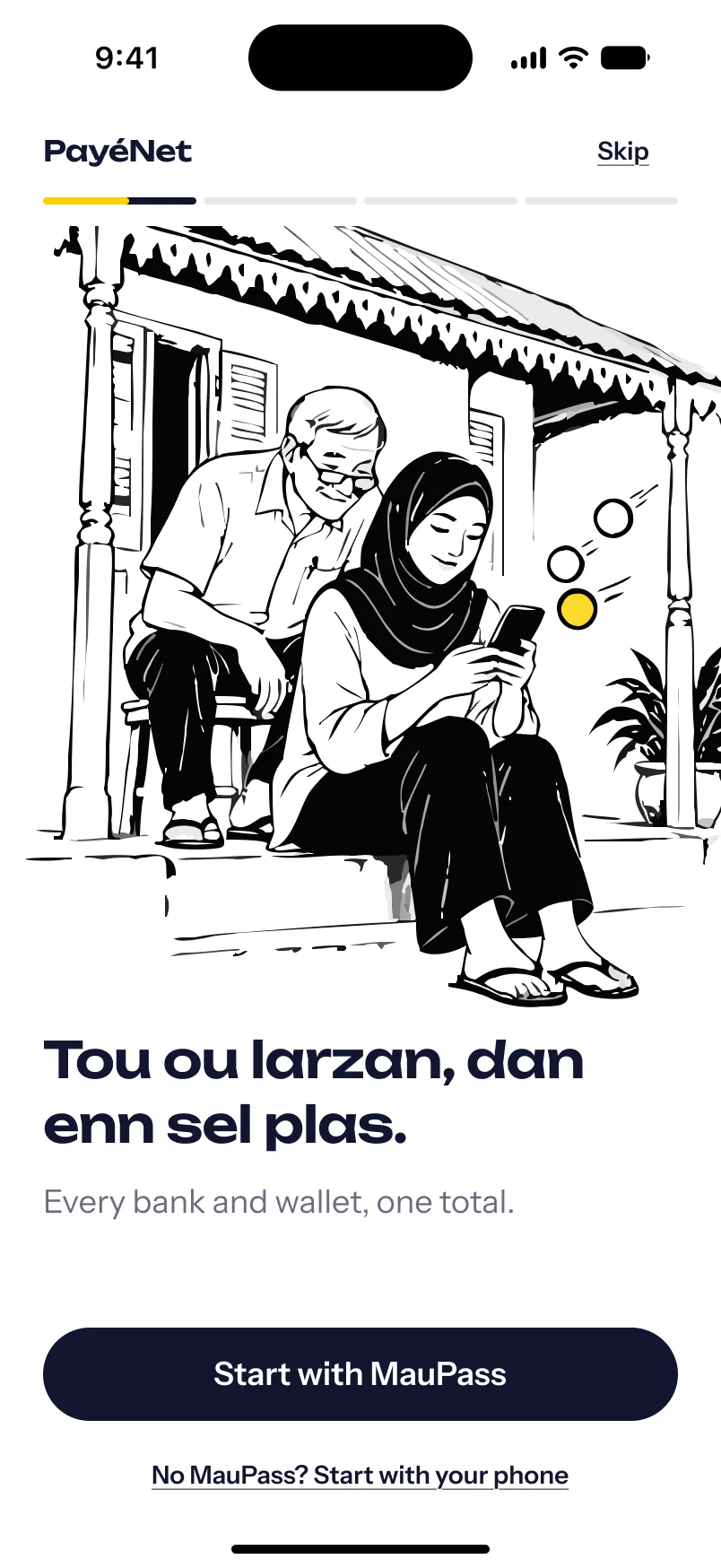
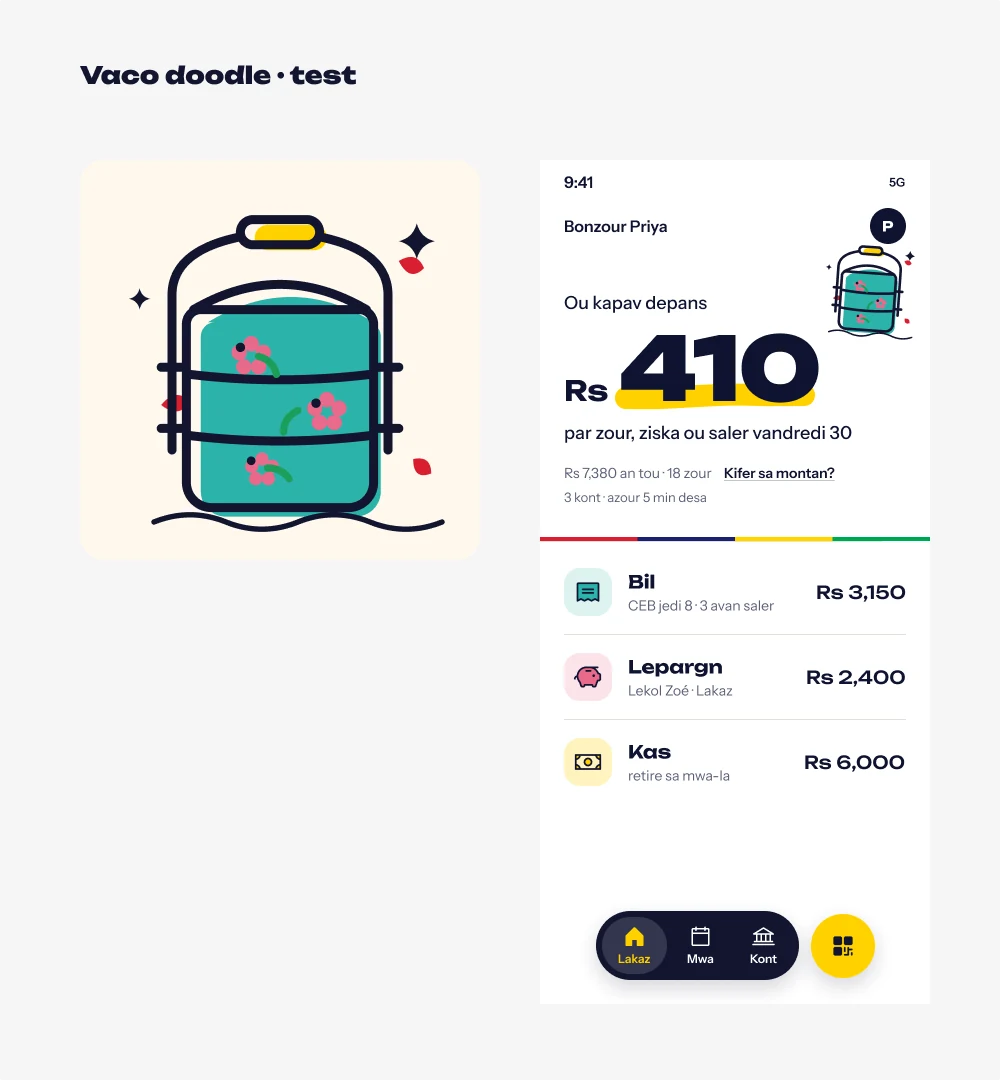
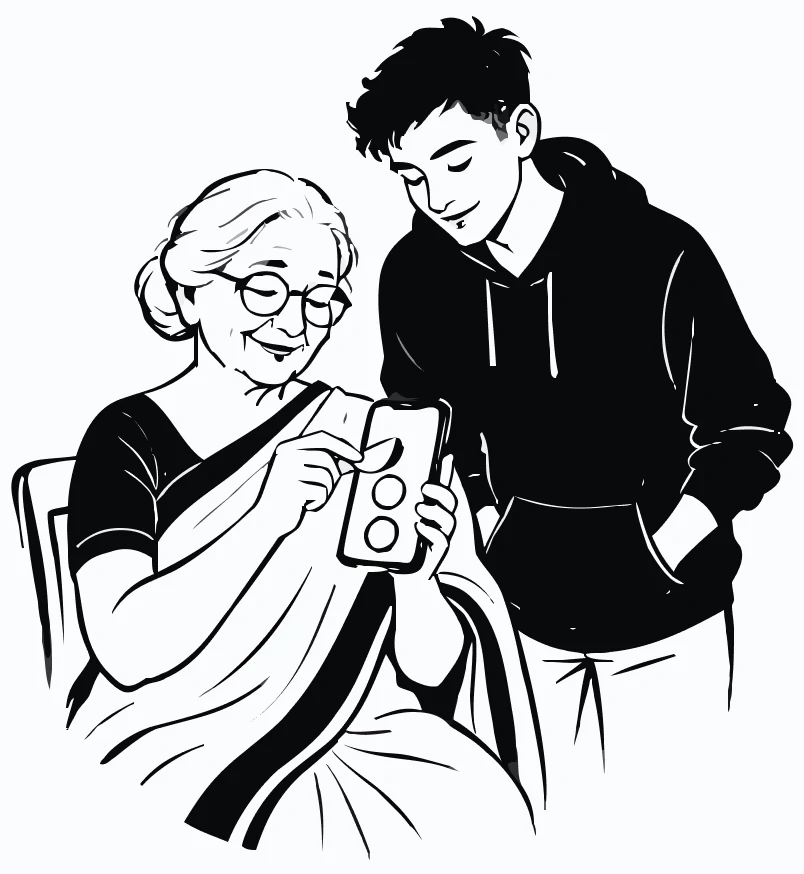
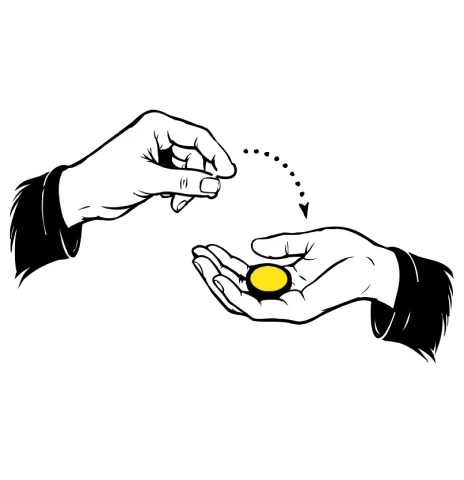
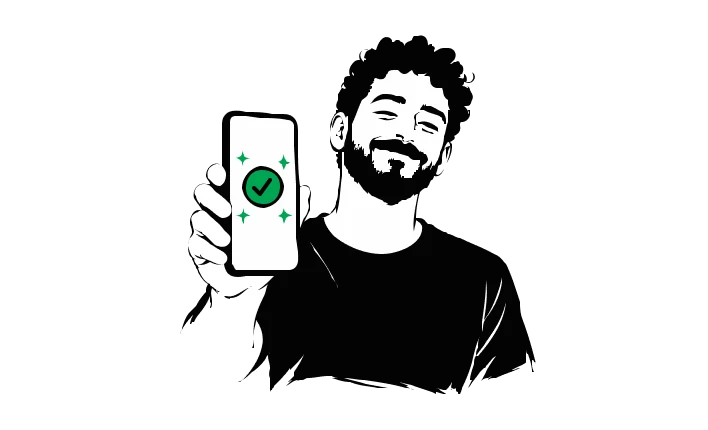
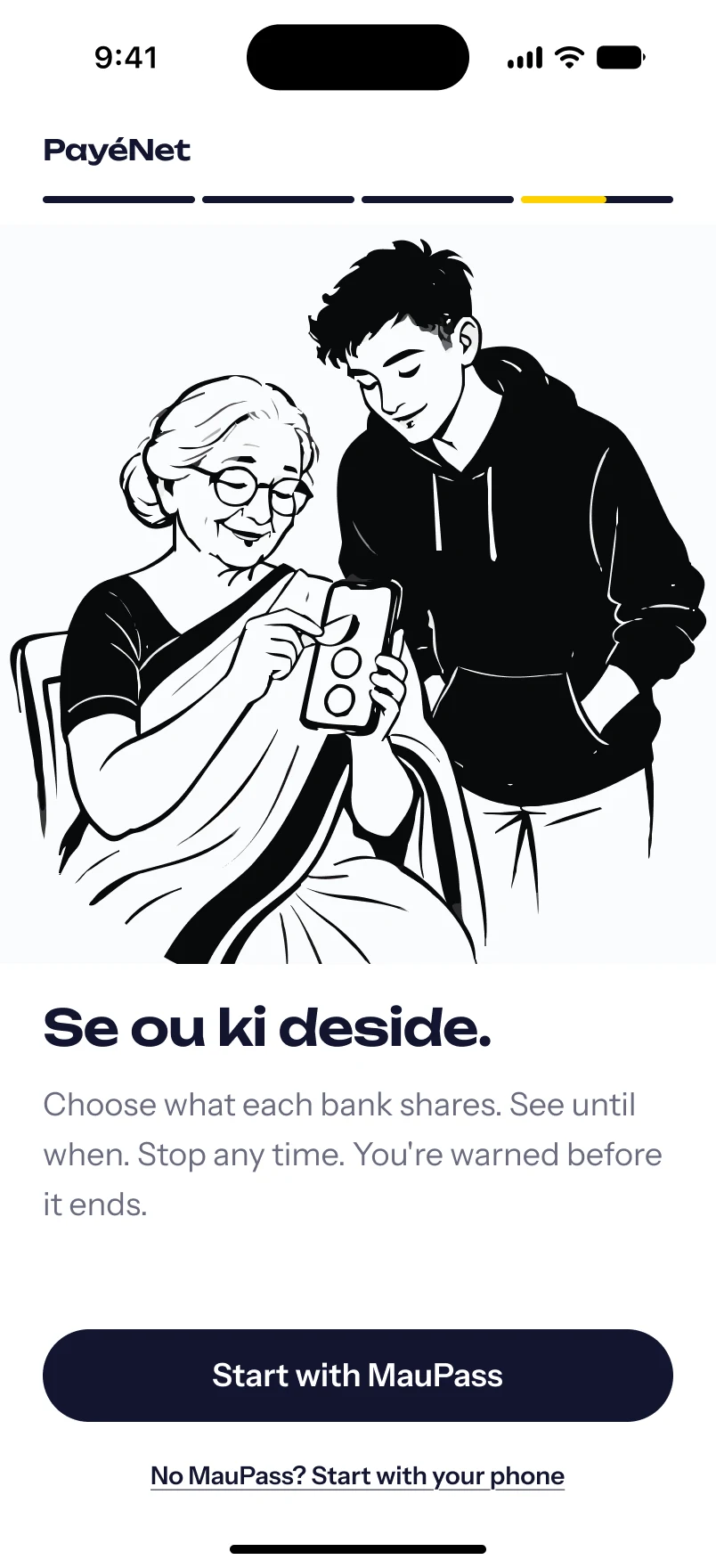
I wanted PayéNet to feel like it comes from here without turning the island into a postcard. Three things carry it: the drawings, the flag’s colours and a few words in Kreol.
The drawings
I used AI to find the direction, over several rounds. If PayéNet were real, I’d ask Mauritian illustrators to draw the final set.
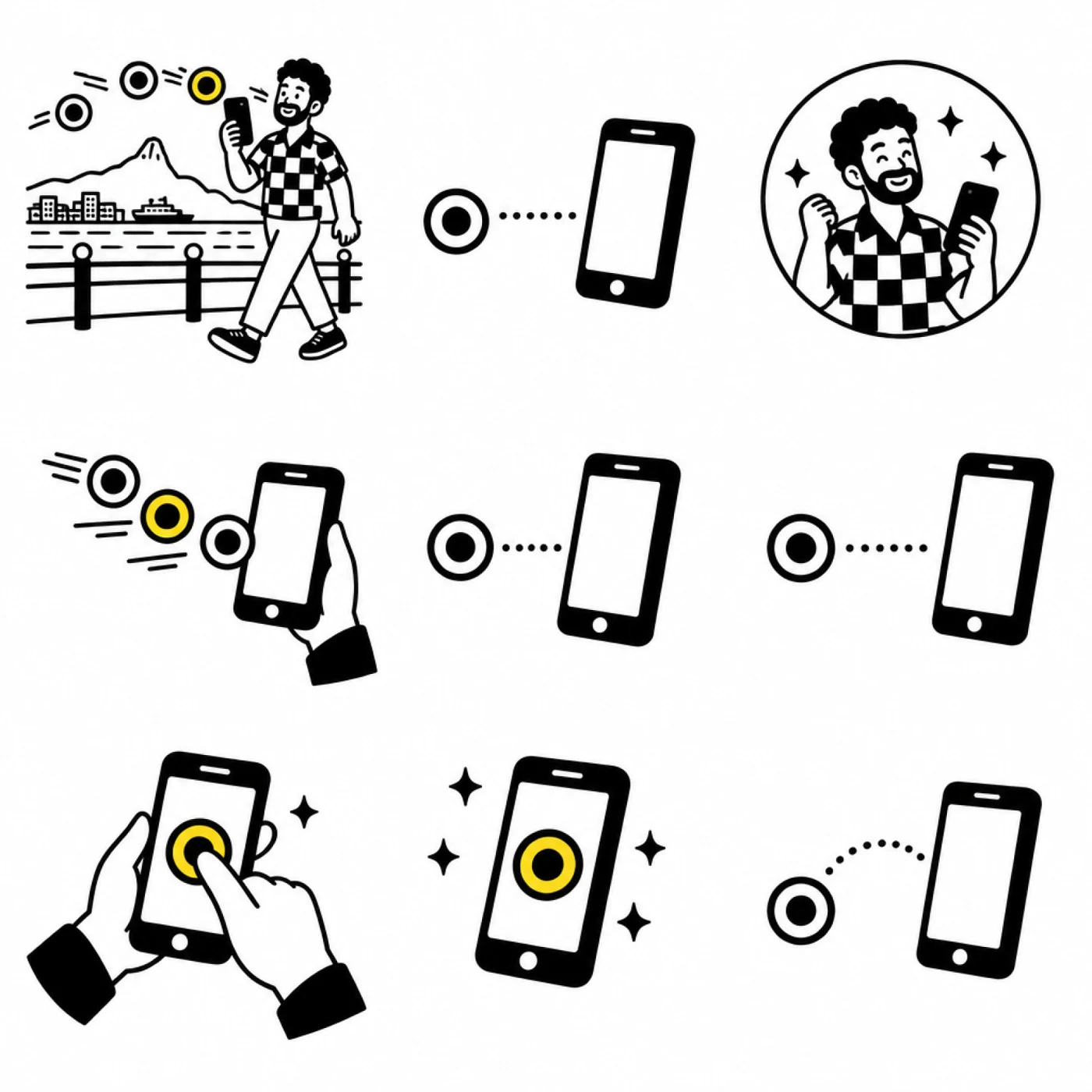

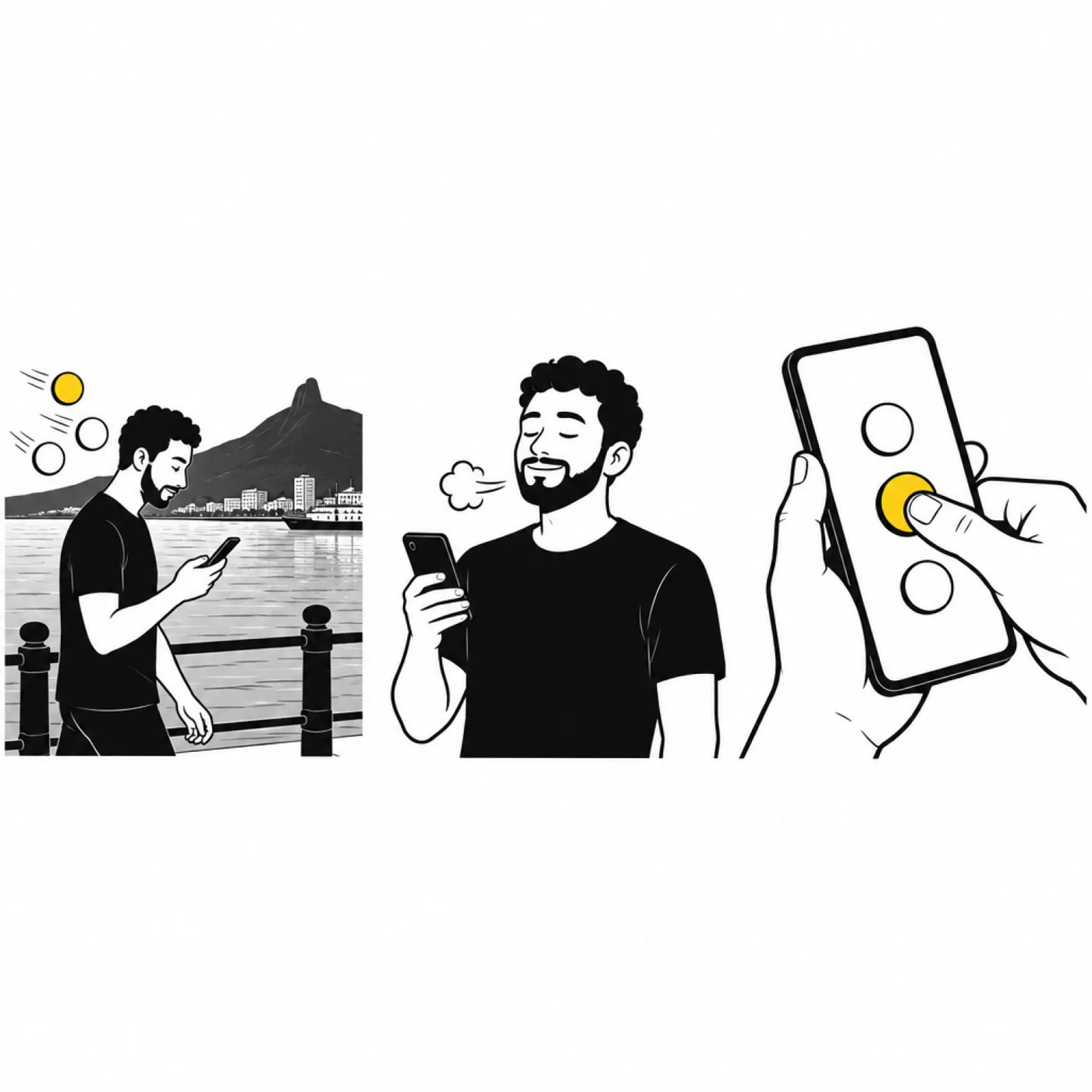
The style prompt
Brush ink illustration for a mobile banking app, warm and everyday. True black ink on pure white, drawn with a brush pen: every line swells and thins along the stroke and tapers to a fine point at both ends. … Wherever a person or a place appears, it is Mauritius today, an ordinary, well-kept, modern island town, never a beach postcard.
I asked for both, in one style prompt pasted unchanged before every picture so the set stays one family. Then one prompt per scene: seventeen pictures and eight places. The ones I kept were traced to vectors in black, white and one yellow.
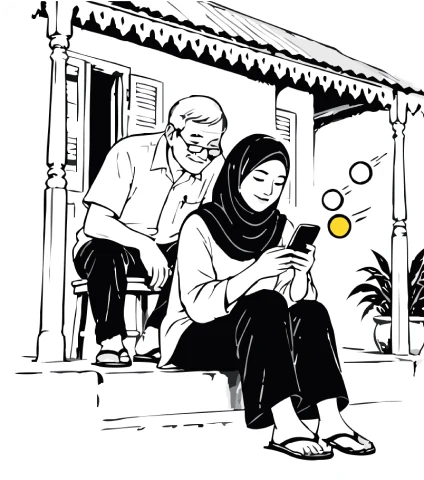


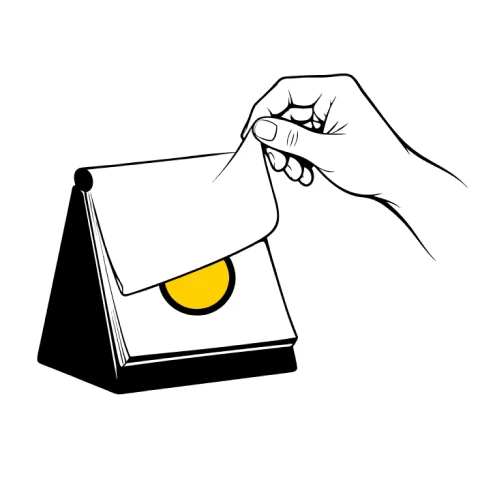

The colours
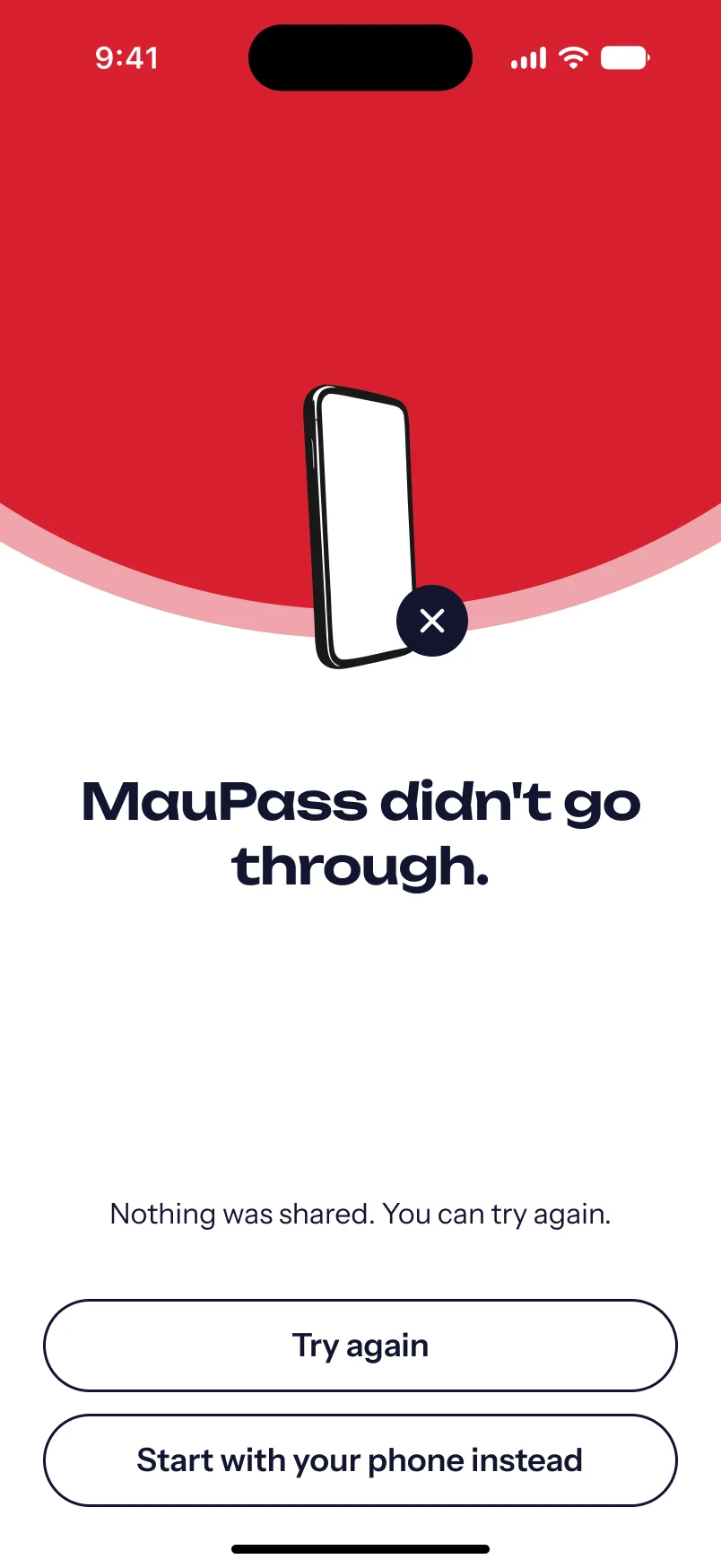
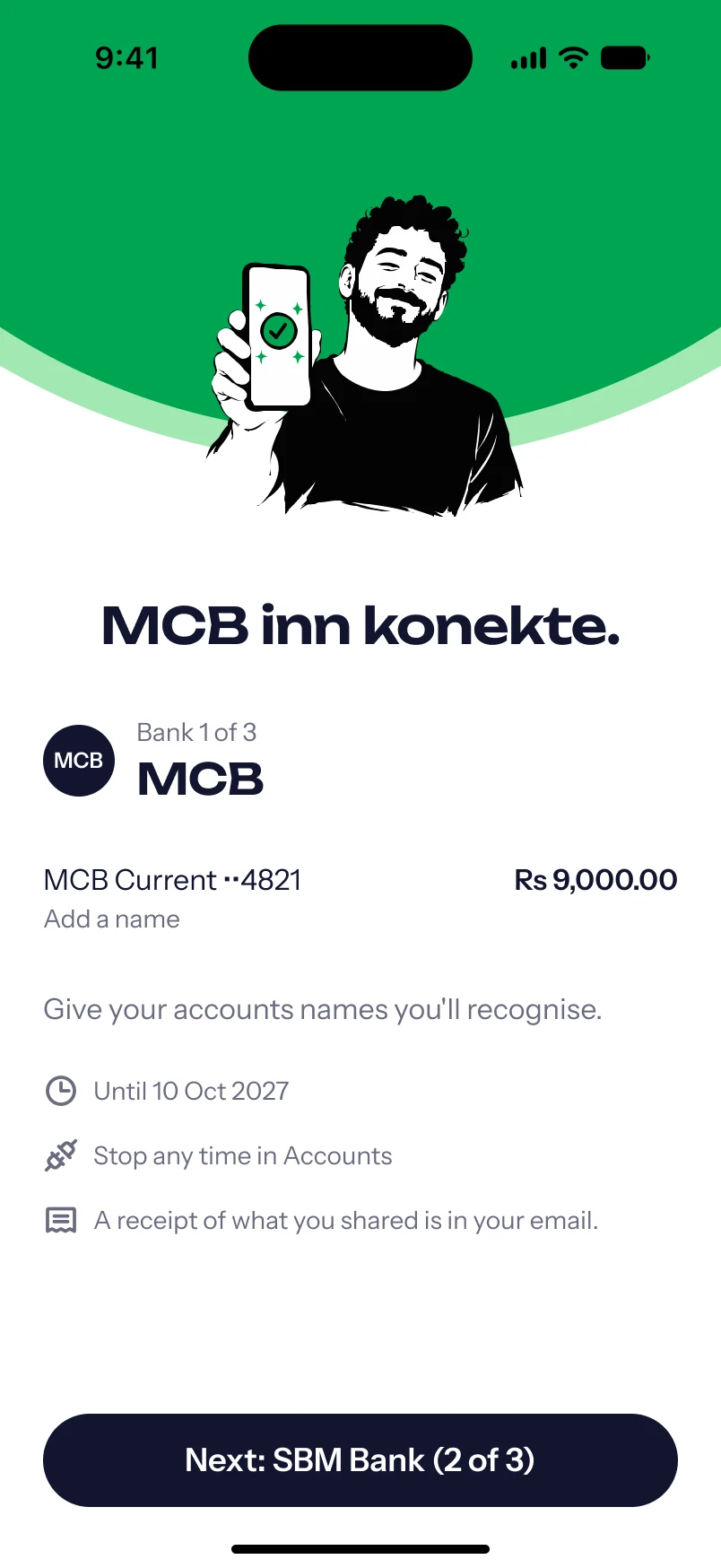
I wanted the flag’s colours as meanings, not decoration. In the flag’s order: red when it goes wrong, blue when you have to focus, yellow for paying and for a moment of relief, green when it goes well. Everything else is ink on white, every button included.
What the colours cost
Green on white is 3.2:1, so green is a field or a shape, never words. Words never sit on the red. The flag blue is too close to the ink to read as a small word, so it’s only ever a big field.
With four colours taken, “waiting” and “old” have none. They’re said in ink, with an icon.
Every pair was measured against WCAG and simulated for the three main kinds of colour blindness.
Whether people read the colours as meanings, and not as the flag or a party, is something only a test with people will tell.
The words
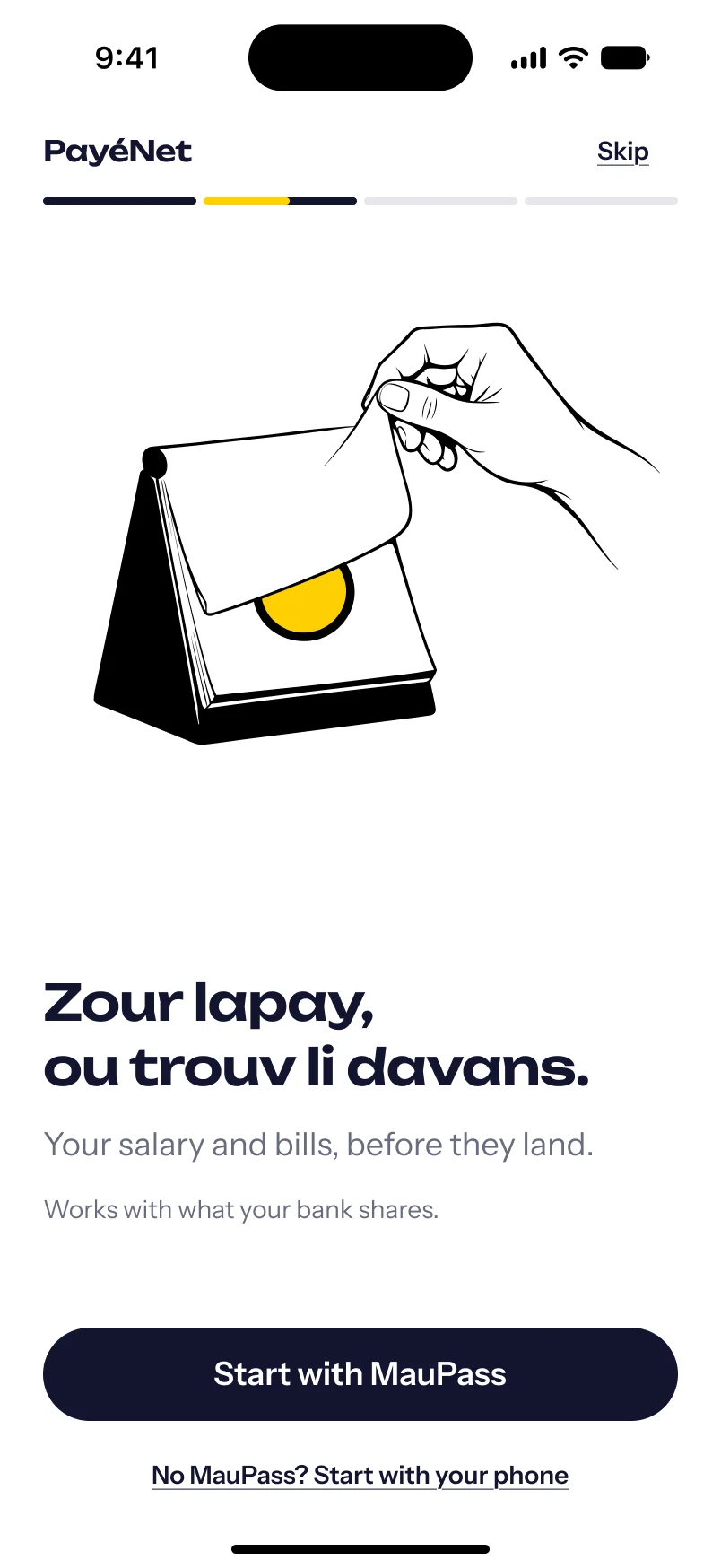
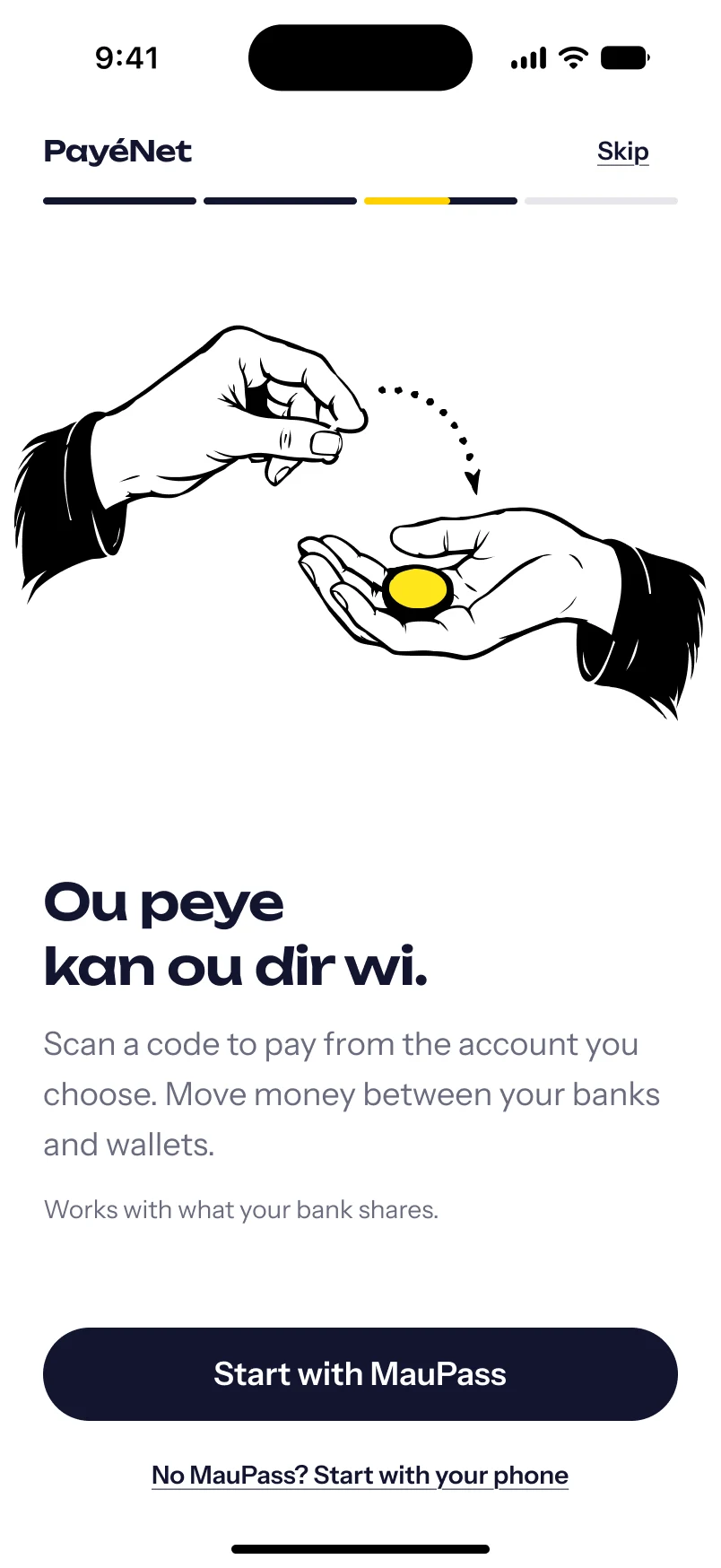
Kreol shows up at the moments that matter: the welcome, a bank that connects, a bill that’s paid, hello on Home. What you have to read carefully, like what you agree to, is in English, down to the tabs: Home, Plan, Accounts, Profile. The name plays on it too: “peye net”.
- Ou peye kan ou dir wi.
- You pay when you say yes.
- Se ou ki deside.
- You’re the one who decides.
- MCB inn konekte.
- MCB is connected.
- MCB inn renouvle.
- MCB is renewed.
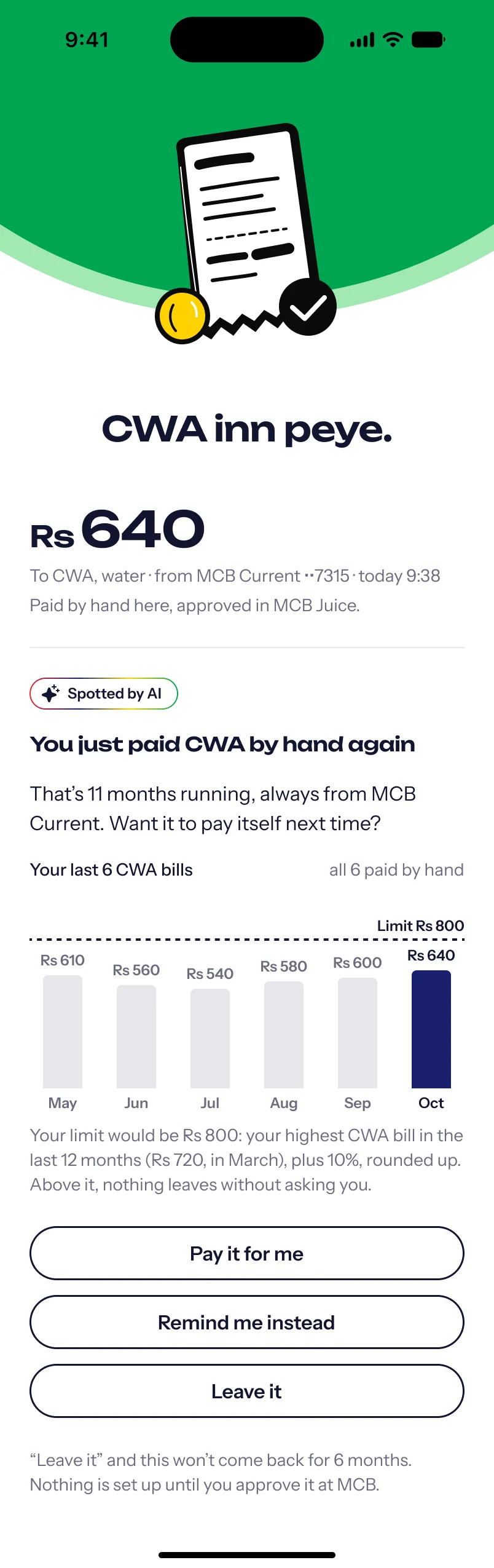
- CWA inn peye.
- CWA is paid.
- Bonzour, Kavish
- Hello, Kavish
Kass, one library for every screen
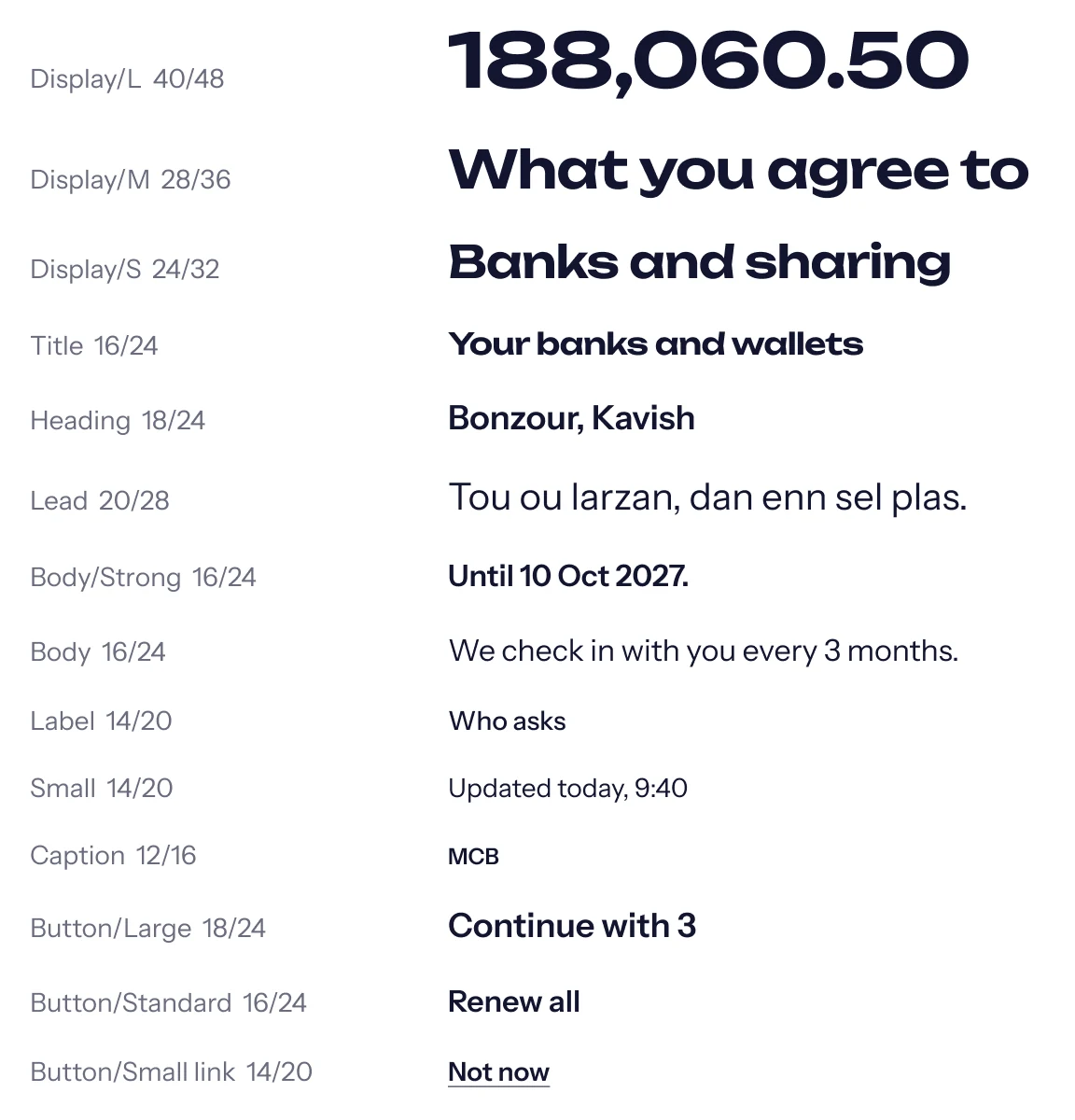
Kass is the design system behind PayéNet. It lives in its own Figma file as a library, and I built it from the screens I had kept in the explorations, not the other way round. Its variables come in three layers: primitives, roles with a light and a dark mode, and a few component settings. I checked it against Material 3, Apple and Polaris, and gave each foundation its own page. The PayéNet App file uses the library, so the screens are built from its parts, except the drawings and a few one-off rows.
Primitives
Semantic, light mode
- bg/canvas → neutral/0
- text/default → neutral/900
- text/muted → neutral/500
- action/primary → neutral/900
- action/key → yellow/400
- field/focus → blue/800
- field/fail → red/500
- field/win → green/500
Type, at real size
Space, 4 px grid
Radius



 AI mark
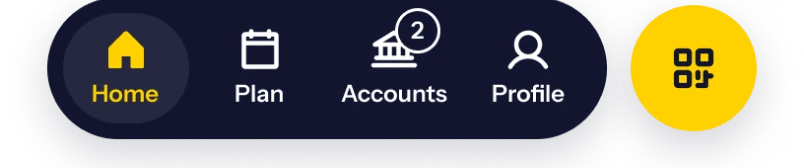 Tab bar
iOS habits, without the glass
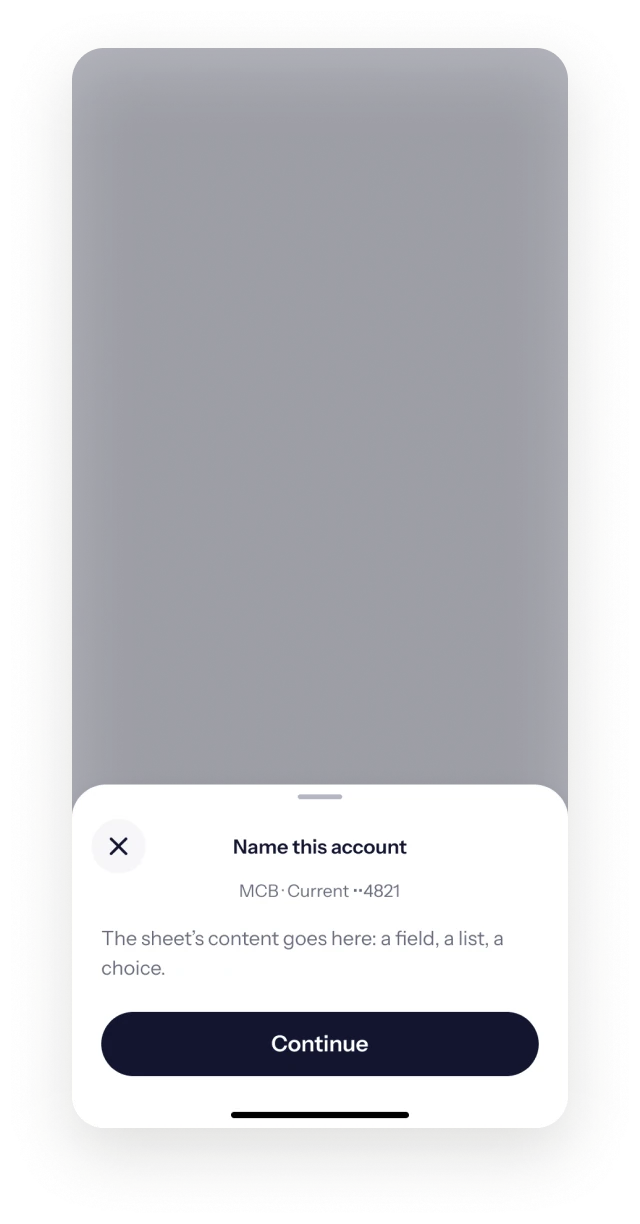
iOS 26 brought Liquid Glass, and I left it out. The see-through, blurred materials clashed with the ink and the one yellow. What I kept is how an iPhone works: tabs at the bottom, back at the top left, sheets that slide up with a grabber, the usual gestures. So Kass has its own Sheet, built on Apple’s model but flat and white. The keyboard is the one exception. It belongs to the phone, not to PayéNet, so it stays Apple’s.
Try it: tap the screen to read each step
How it moves
I wanted the drawings to have some personality, so each one gets one move: the coin hops from one hand to the other, the calendar page lifts. The screens around them stay calm. I looked at Duolingo, Cash App and Revolut for the character. With reduced motion, every screen shows its end at once.
Only where there’s nothing to do
Welcome, the wins and the waits get a move. Agreeing, the bank’s own screen and anything with figures stay still, and nothing loops next to a number.
The coin stays in the right hand
In the first pass the coin hopped back to the giving hand. It read as the payment being undone, so now it lands and stays.
Slides, not fades
Screens push like iOS. When two screens faded through each other, the drawings showed through the text.
A failure you can see
When MauPass fails, a red field drops in like a curtain and the phone shakes its head. Then the words and the two ways out.
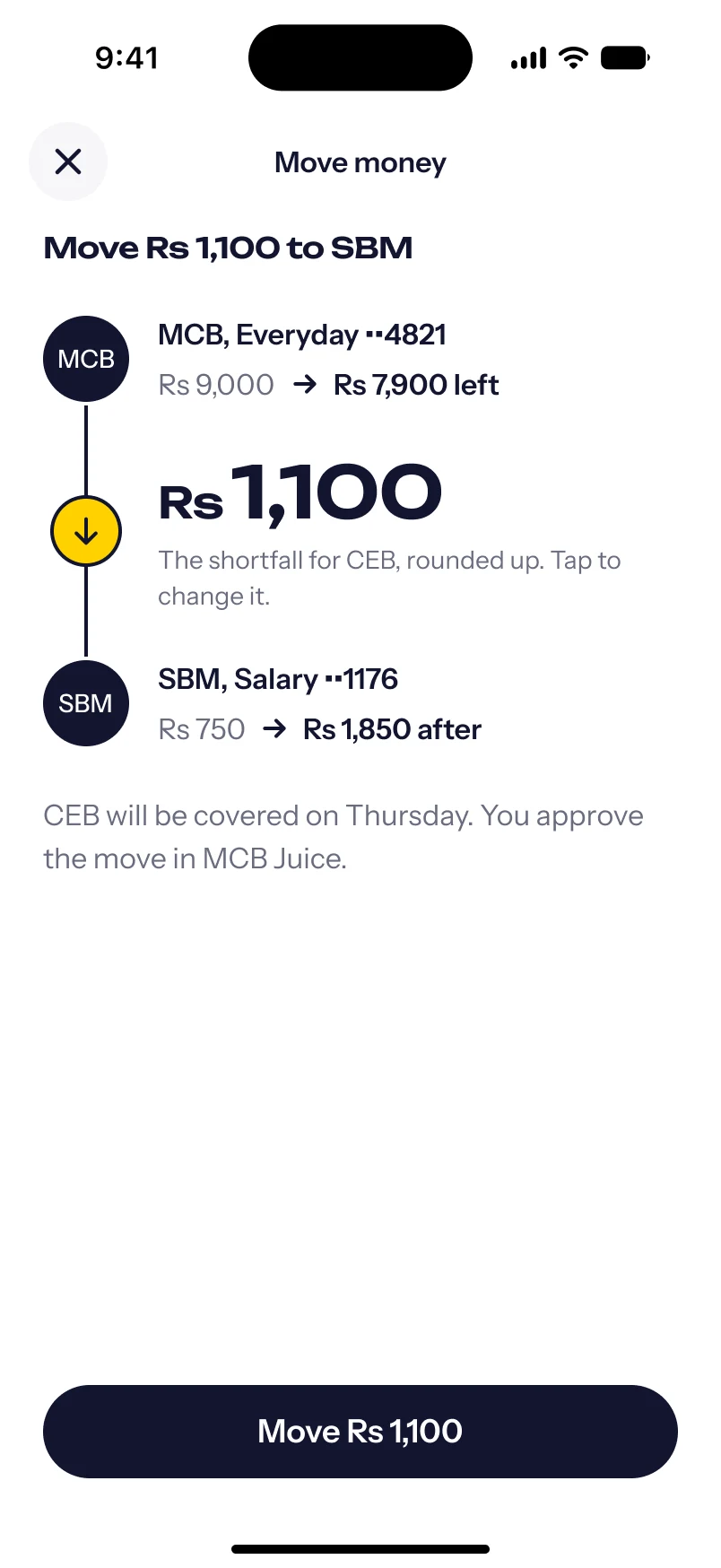
Try it: pick an answer, then tap Move
When money moves
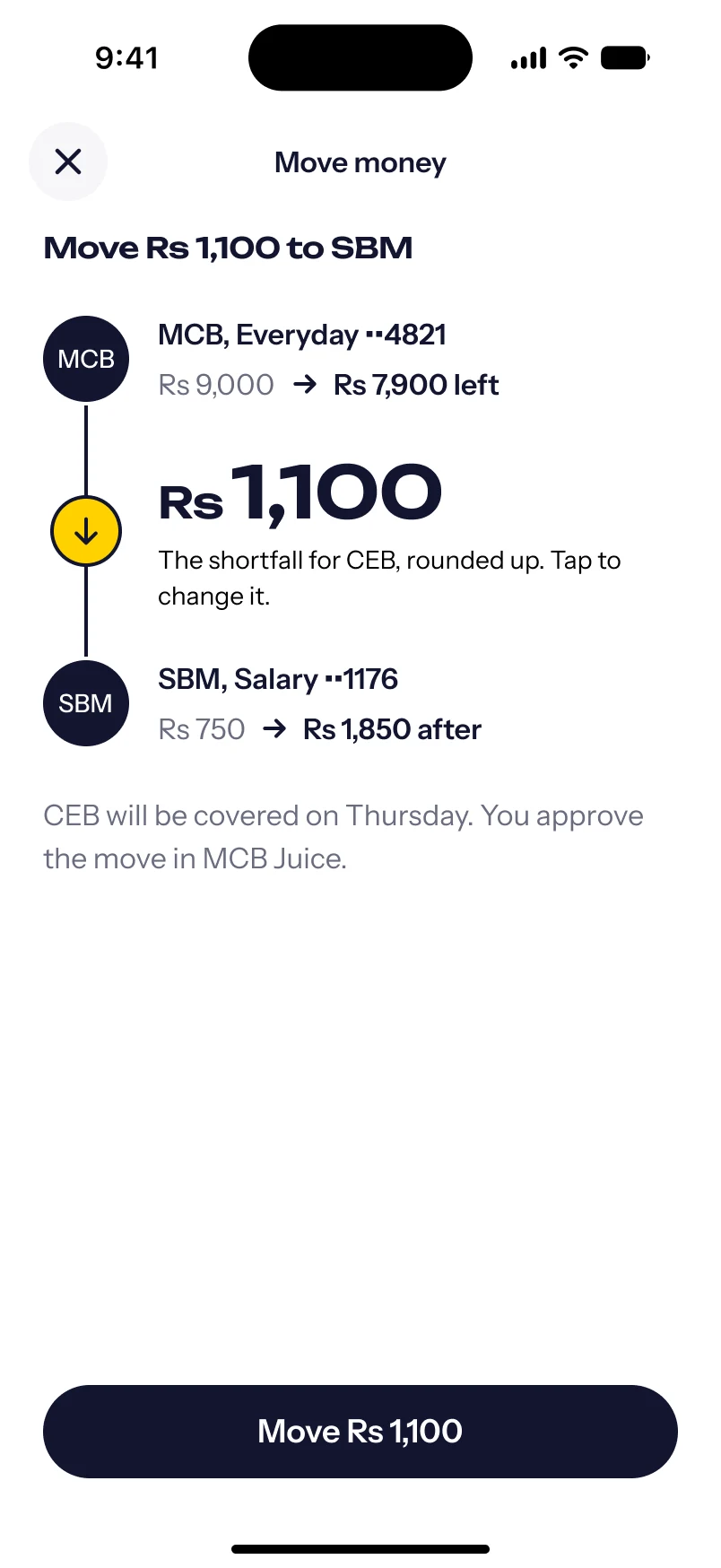
Moving money between your own banks takes a moment, because MCB has to say yes in MCB Juice. So the wait gets its own motion: the yellow circle flies down the line until MCB answers. A yes lands it in SBM with a small celebration, a no sends it back behind the red curtain, and if MCB takes too long, everything slows down and you can leave.
What stays when you scroll
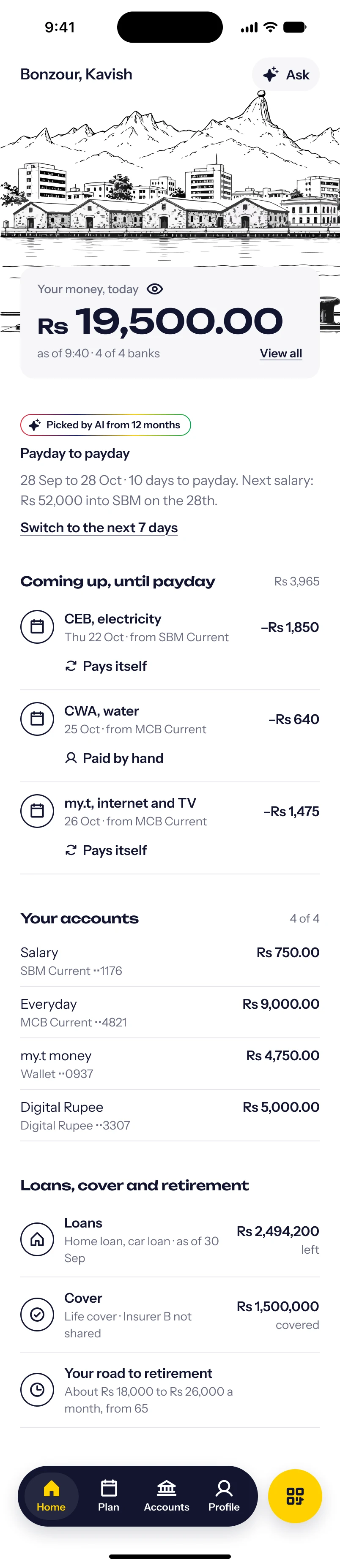
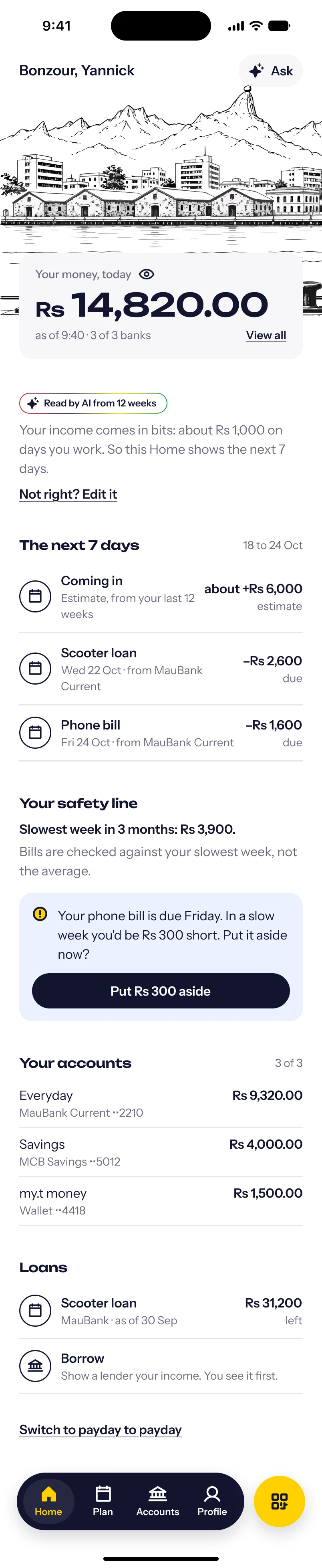
A long screen shouldn’t lose the one thing you opened it for. On Home that’s the total: the drawing moves at half the speed of your finger, the lists slide over it, and when the total reaches the top it comes back small in a white bar. On the blue moments, it’s what you’re being asked: the blue field folds into a bar that keeps the question and the bank, and the button stays at the bottom.
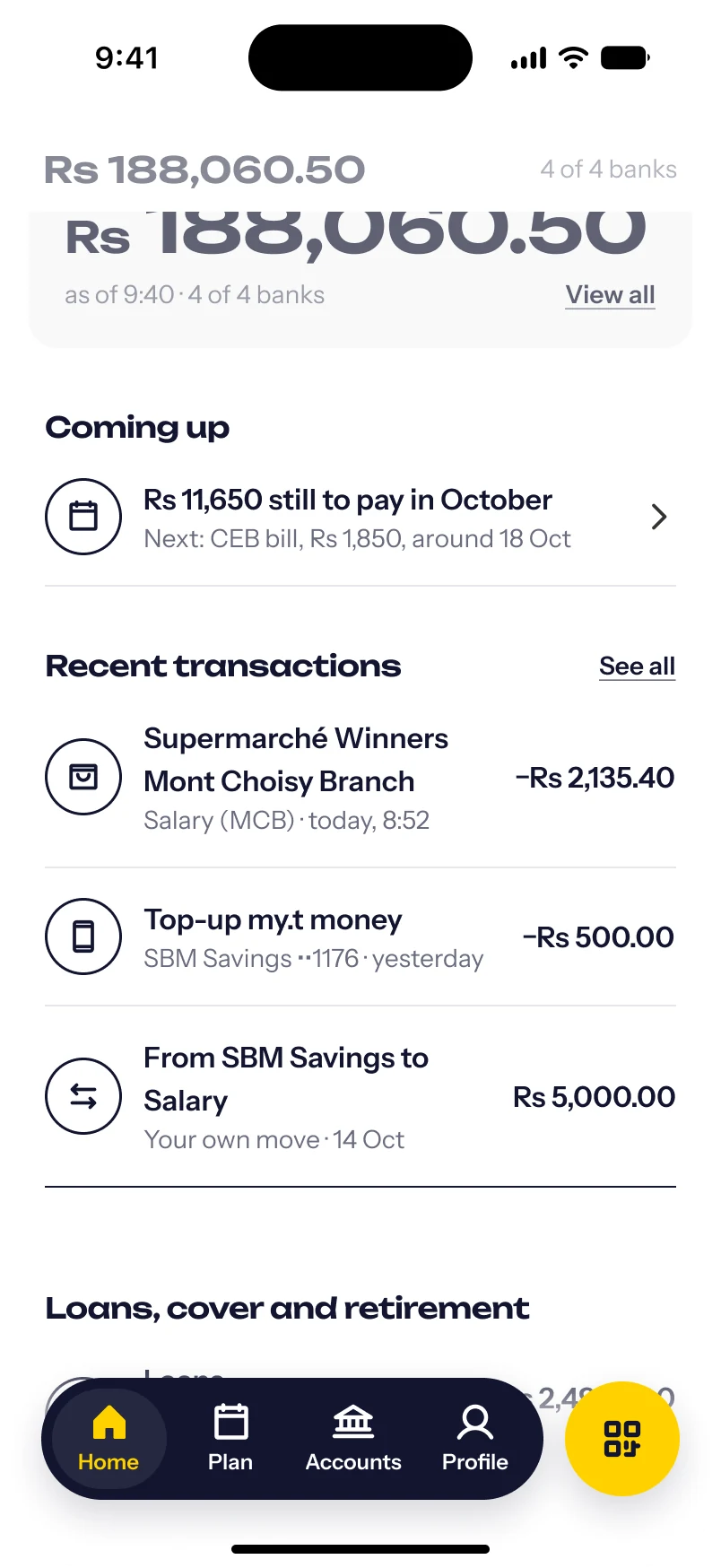
Try it: scroll up and down
Try it: scroll up and down
Where the AI sits
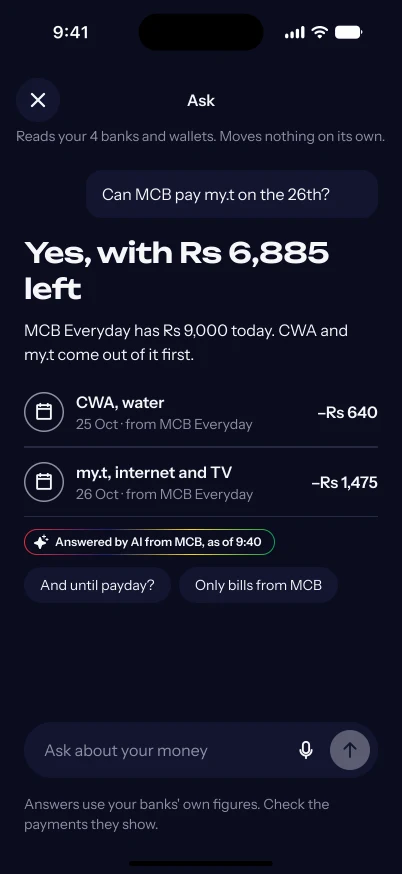
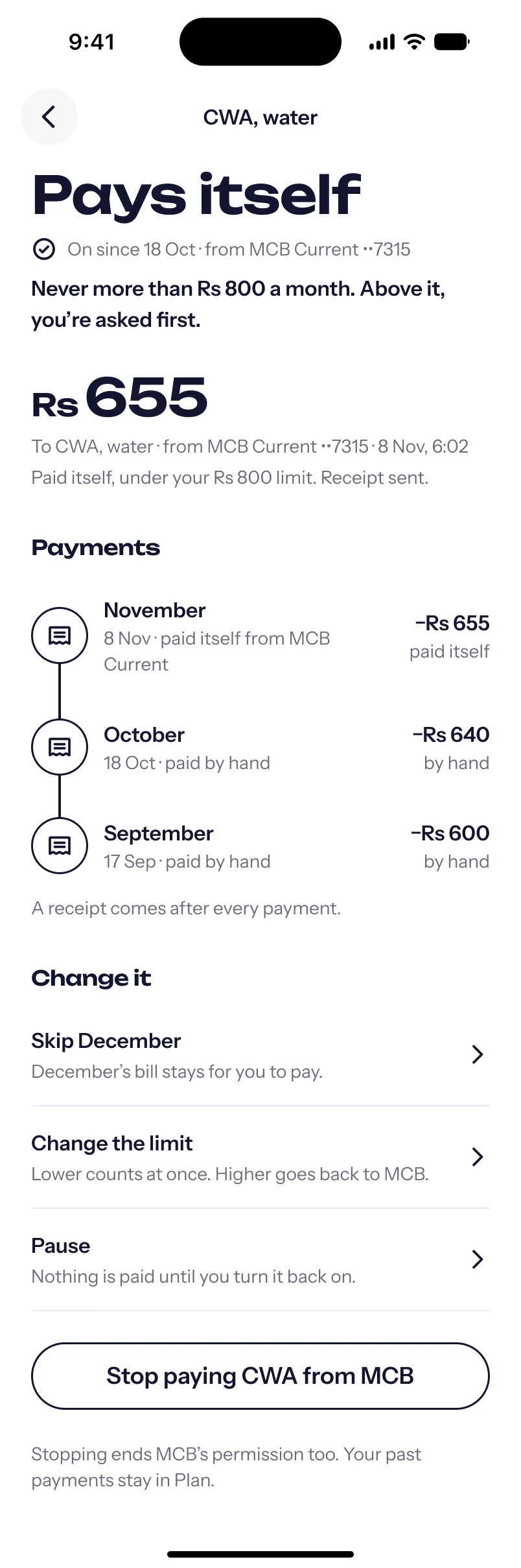
The AI reads your past bills and says what it spotted. It never makes the numbers; that’s arithmetic. And when you want to ask something, Ask opens full screen: you say it, it reads your banks, and it shows the payments it counted. None of it is required: you can turn the AI off, and PayéNet still shows your money, your bills and your moves.
What comes next
Next, I want to show it to as many people as I can, starting with the Bank of Mauritius and the fintech players here. I want to find out if an app like this, with this kind of UX, has a place in the ecosystem.
It isn’t meant to replace the apps people already use. It’s meant to enrich the fintech experience of Mauritians.

I made all of this with a tool I built.
I can’t show it yet. It will be available soon.
- Figma
- Claude
- Rive
- GPT Image
Want to know more about PayéNet, or the tool?
Write to me, I’m happy to walk you through it.